
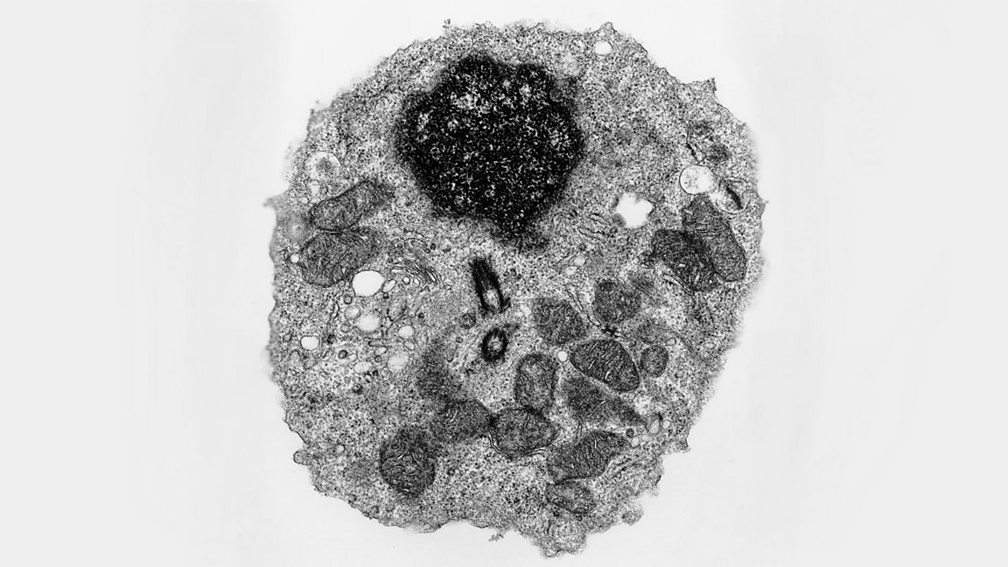
Your typical cell. A live critter but…
It doesn’t have a self, yet. It doesn’t see, hear, think or feel. Doesnt scratch it’s butt in response to an itch, think about what’s for dinner, or notice the dog peed on the rug…again. It doesn’t have a mental representation of it’s self. But it does have a boundary. A membrane which separates cell from not-cell. The cell being something separate from everything else, a self-contained unique, individual entity is not an illusion, not mysterious.

Once critters evolved nervous systems that model the world employing the consistent perceptual input they receive – to predict what’s happening out there (brains are prediction machines), they may also model their own bodily boundaries and sensations – the bodily self as the neuroscientist Anotonio Damasio calls it.
Us humans have a more complex embodiment than just a bodily self, and our brains predictions are steeped in theoretical understanding of the world we model in our heads, and most important with our selves as independent people contained within our bodies moving thru the landscape of the world around us. It is what we do with our consciousness every waking minute. We model the outside world – also from the very consistent perceptual input we receive every waking moment. Even when we are asleep – our brains still register input such as sound – some will wake us up (babies’cries and fire alarms will almost always rouse us), and the photons from the morning sun will penetrate out eyelids and wake us – OK, not always. But the perceptual input we receive, whatever the modality is common and consistent: the sun rises, the wind blows, the photons from the sun bounce off everything out there beyond us illuminating every object and creature, allowing us to see all the things in the world in the same way, day after day after day.
We are not expressing a controlled hallucination of some kind. What we see and hear is there.
We construct a model of what is out there, in complexity far beyond that of any other animal, and an increasingly accurate one, thanks to modern theoretical science. The model is populated by people, objects, and things going on (events – processes happening) in that outside world. With the right drugs, or oxygen deprivation to the brain we might hallucinate, but it is not very often.
Young children notice object properties and build a ToO -Theory of Objects – noticing all sorts of things beyond their bodies, they later name them. Children also operate with ToM, a Theory of Mind, where they ascribe mental states, emotions, intentions to others – that others have a mind just like theirs. They and other people, even many living things like animals are thinking, feeling beings moving about the landscape, separate from it and from each other. This develops in increments all thru infancy but is most apparent after age 3-4.
But more importantly and prior to and necessary for ToM to develop, ToS or Theory of Self I suggest, develops first.
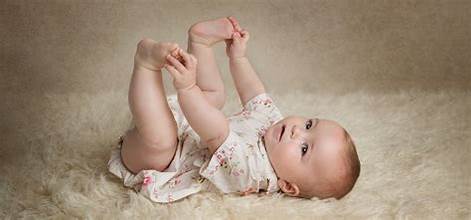
First bodily boundaries are discovered: they discover me and not-me: the rattle and other objects don’t feel like their own hand, toes, or clutching their own clothing. Imitation, especially with regards language sounds begins around 3 months when cooing and babbling begin. The baby hears the parent making speech sounds, and tries to imitate those sounds (just vowel sounds at the beginning, full syllables later) and hears and feels their own self making those sounds. By 10 months they will turn their heads in answer to their own name being called. By 18-24 months they will finally and completely recognize themselves in the mirror:,”Hey, That’s me!”.
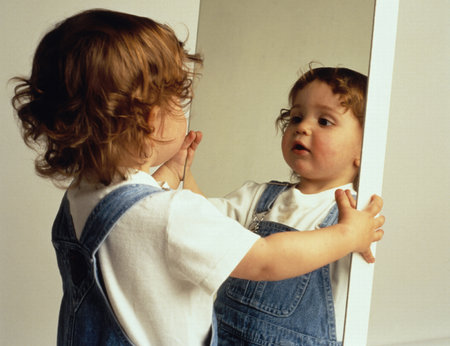
So the beginnings of a full self-concept, the ToS as I call it, needs to develop before ToM: you need to recognize that you are a “you” – a being with thoughts, feelings, sensations, before you can realize others are mental creatures as well, having the same sort of experiences.
“I’m Jimmy, and I’m this many, and I like my puppy”
And it truly never ends. We add to our self-concept daily throughout our lives in experiencing and then recalling the events in our life, building each our own unique set of episodic memories which define us.
And unless brain damage, dementia, drugs, or alcohol dampen our memory and sense of self, we wake up to our selves every morning and pick up right where we left off the day before. Seems to me as natural as can be, the Self developing in increments as different areas of the brain wire up and come on stream as our conceptual model of the world expands with us moving through it. It is such an obvious product of the long evolution of nervous systems and the normal development of each our own uniquely configured human brains throughout the long human childhood.
For many, the idea of the self and our experience of the world and ourselves in it, is some mysterious, nebulous, wholly impossible to fully describe or understand, kinda thing…
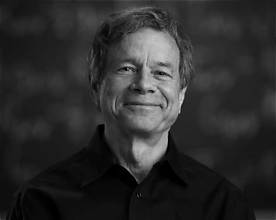
Dr. Alan Lightman, physicist and author on the subject, from his 2023 book; “The Transcendent Brain”:
“Let me acknowledge straight off that the highest level of experience we call consciousness – the first-person participation in the world: the awareness of self: the feeling of “I-ness”; the sense of being a separate entity in the world; the simultaneous reception and witnessing of visual images, sound, touch, memory, thought; the ability to conceive of the future and plan for the future – all of that is so unique, so hard to describe, so different from experiences with the world outside our bodies that we may never be able to fully capture consciousness with brain research. We may never be able to show in a step by step manner how this highest level of consciousness emerges from neurons and synapses of the material brain. That is not to say that such an emergence does not occur. We may be able to show that the feelings and attributes we call consciousness are generated by material structures in the brain without being able to fill in all the blanks”
What makes folks like the good Dr. Lightman assume this to be true?
I’ll call it “The Mystification of the Self” and it has a long history in the world’s Eastern religions, and is a very common viewpoint even in today’s modern world. It is as if we haven’t learned anything since the musings of the ancient mystics.
I think this perspective in its many forms: “Oh it is just TOO MYSTERIOUS, we will never figure it out – We havent the cognitive capacity to do so” (Colin McGinn), or “There just must be something more – IN PRINCIPLE mere matter isn’t up to it!” (David Chalmers),or “The Great Contemplatives figured it out thousands of years ago – its just an illusion” (Sam Harris), or “Oh consciousness is everywhere, the brain cant do it alone” (Christof Koch) is just a reflection of “common knowledge” (and I use the term “knowledge” loosely). For lack of a more precise term, maybe “Zietgeist”, “unquestioned assumptions”, “religious outlook” “cultural perspectives”- that refer to ideas in the culture that just seem right, plausible, have intuitive appeal – yet may have no evidence for them and reflect only an aspect of our own evolved, very human psychology and not anything accurate about how the world really is.
To put it more bluntly: I call bullshit.
Although Dr. Lightman, unlike many others, stops short of anything other than materialism, he subscribes to at least a Minimal Mystification (my term) that “selfness”, “I-ness”, the first person perspective is so “hard to describe”, “unique”,” different from regular perception that we will never “fill in all the blanks”.
Being a physicist, an educated scientist and accomplished author – he has a rather parochial view that would be expected among non-academic folks, but those of his stature? Given his education and experience, he surely knows the history of science as well as anyone. Especially since he knows physics and science in general, that when modern scientific investigation just exploded over the last 150 years, how often something was deemed to be mysterious, beyond our knowing, or maybe had to be the result of immaterial forces…that each time those pronouncements were proved not merely dead wrong, but in retrospect, almost silly.
Physics was claimed to be complete in the late 1800’s, there was nothing else to learn. We would never know anything more. How wrong the discoveries of radiation, atomic structure, and eventually quantum mechanics proved that perspective to be, eh? Philosophers claimed we could never know the composition of the stars, or the planets could only be exactly the seven we knew of at the time – both pronouncements of the late 1800’s proven incredibly myopic within a decade or two. And prior to these examples from physics and astronomy, in the life sciences a spiritualist vitalism proclaimed mere matter could not explain the mystery of life: until we discovered and described the biochemical processes and structures of the cell in all living things to be solely material in form and function: no mystery, no spiritual essence necessary, nor in evidence. Mental illness such as schizophrenia or epilepsy must have had a spiritual, utterly non-material cause – demonic possession. Plagues and other illnesses: the work of the devil, or punishment by an angry god.
Each time we made the claim that something was ineffable and/or required some sort of non-material spiritual essence to explain something we hadnt quite figured out yet – we were wrong. Maybe, just maybe, we could be just as wrong about the necessity of something non-material to explain consciousness and the Self beyond mere neurons in the brain, and maybe just maybe as we learn more and more about the brain, we may be able to explain all or most of it. Could it be given a good deal more time to probe and explicate the immense complexity of the human brain, we might fill in most, maybe all of the blanks?
Methinks it is a bit too early in the game to succumb to intuitively appealing spiritual “something(s)” or commit to the perspective of “we will never be able to explain it” as our modern investigation of the brain is barely decades old. It is one thing to say: “We don’t know about X – and maybe one day we might or might not figure it all out” It is another thing altogether to claim:”We don’t know about X, but we do know we wont ever figure it all out”.
My answer to that second claim is “and HOW do you know that? You just said we don’t know about X, but now you are saying you do know enough about it to know we will never fully know about it”. That commitment, I believe to be more than a bit premature.
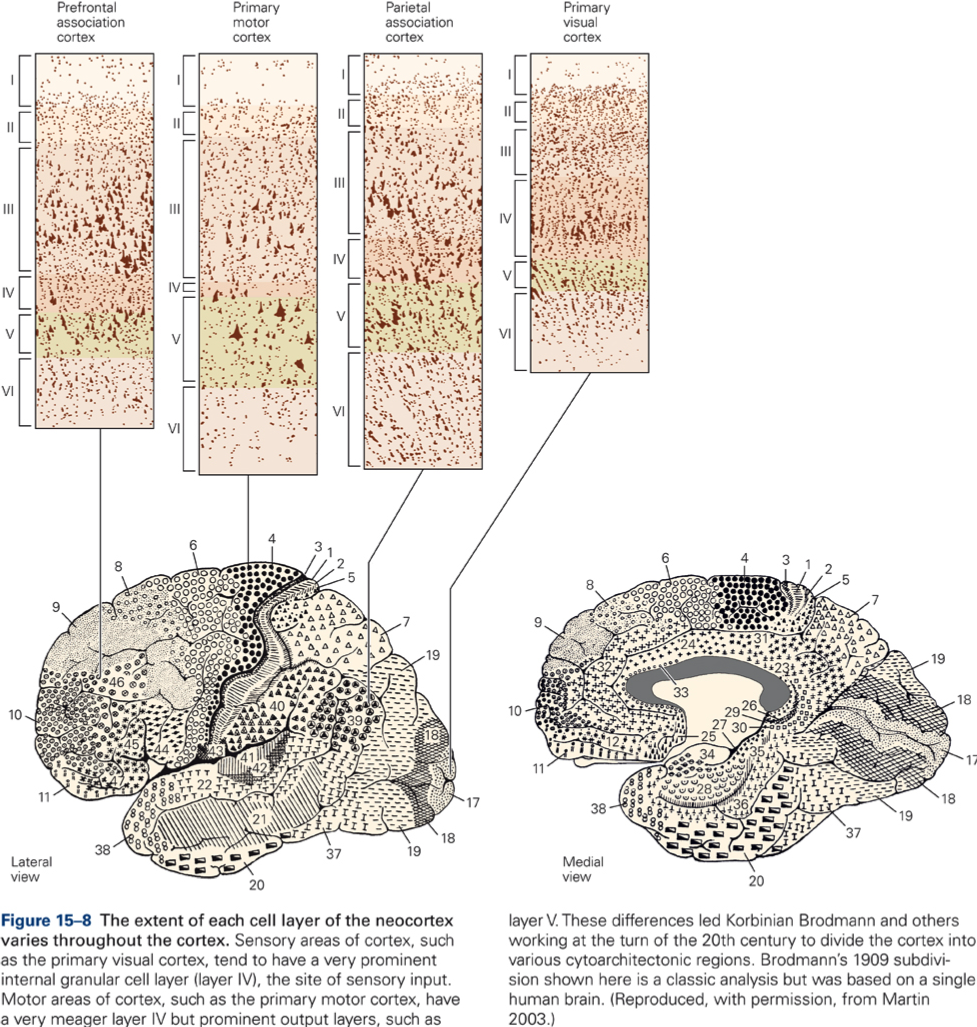
Neurons were only discovered in the late 1800’s, not even 150 years ago, and the functional unit of our higher brain functions: cortical column architecture, was first proposed but 60 some years ago. The theoretical intricacies of cortex structure just being expanded upon in the last 20 years or so. Regular CT, MRI, MEG, DTI, and other visualization techniques are only a few decades old. We have yet to count every neuron and are nowhere near mapping the trillions of connections between them or all the separate functional areas. Neuroscience is in its infancy in comparison to physics, chemistry, or biology, and has just barely begun explicating the immense complexity of the human brain. I think it is incredibly myopic to claim about brain functions, consciousness, or self-ness: “We might never know”, or “We probably cant know” or “We wont ever know” or its just an illusion anyway…
Think about it, it took roughly 250 years from Newton to Einstein to go from a description of HOW gravity works (Newton’s Law of Universal Gravitation) to a theory of what gravity really is and WHY it works (Einstein’s General Relativity). A sophisticated investigation of human consciousness, using all the tools and discoveries of modern neuroscience is so new by comparison. Given the complexity of the human brain, might we expect many more decades, even a century or more of painstaking in depth research to plumb the depths of the self and consciousness – and then be able to say what the probable extent of our understanding might reach?
Chalmers, Harris, Koch, and Lightman to a lesser degree, seem to me to be expressing just that residual Zeitgeist, the “common knowledge” of our still all-too-religious 21st Century global culture – that there must be a spiritual component, a realm, some ultimate existence, a true reality, an inexplicable component at least beyond the material brain that is ineffable, forever out of touch, beyond our investigation. The self is illusory, must be immaterial, or at very least inexplicable.
Personally, I don’t buy any of it, pace Dr. Lightman.
It seems pretty straightforward how each element of conscious experience with our selves modeled in it just like all the other things we think about and pay attention to, is an obvious product of our uniquely evolved brains, once they grow and wire up during our extensive child development. Our sense of self develops in specific increments mediated by different parts of the brain and becomes an integral, maybe the key element of the model of the world we carry in our heads – constructed through childhood and now enhanced almost daily with the continual findings of modern science. We know so much more about the world from physics, chemistry, and biology, and about our selves and our own development and psychology than ever before in human history.
And today’s level of knowledge is not an endpoint. We are just at the very beginning of explaining brain functions and our psychology. We have made that mistake in science before in assuming at some given time that we knew all there was to know and we couldn’t possibly know anymore.

Our selves, each our own unique identity, is not an illusion. We are unique and real. We have a body boundary that separates us from the outside world. That’s real. My digestion is not your digestion. When I feel sated after a good meal, when I feel queasy with indigestion or anxiety, when I need to eliminate and relieve my self, not you, not him or her, not them, but me, this is not hallucinated or illusory. It is my body and not anyone else’s. My cells, digestive system, neurons, all produce these feelings in me, not you. The world doesn’t feel my bodily functions. I do. The world doesn’t experience my angst or elation, I do. I discover these and learn what these are as a child, describing them in more modern terms today than 100 or 1,000 years ago when people didn’t know even basic biology, what might be ailing them, how experience affected them, or why.
As the child develops, it learns the properties of objects around them, that they are solid, dont move under their own power, dont respond to anything you might do to them. And the child learns that people and they themselves are not like objects in key ways. We may be solid and cant pass through other things just as objects cant, and sit atop tables and chairs and countertops and be supported lying on the floor just like their toys or the groceries, but the infant learns that they like other people and living things move under our own power around the room and feel what is done to us and respond: laugh, cry, hurt, run away, giggle, yell, and so on. We learn we aren’t objects. Our self has a body and is a living thing. This knowledge is implicit at first but becomes explicit during the toddler and young childhood years.
This self knowledge is succinctly expressed in the “brain as container” metaphor that children understand by grade school, despite no-one having explicitly taught them about it. They will answer if a brain of one animal or person is exchanged for another that the behavior and feelings of that brain will now reside in the animal or person receiving the transplant. The brain contains the essence of what someone, any critter is. The self, who we are, resides in the brain situated within a body, me in my body, you in yours, Fluffy and Rex have their essences residing in their brains too.
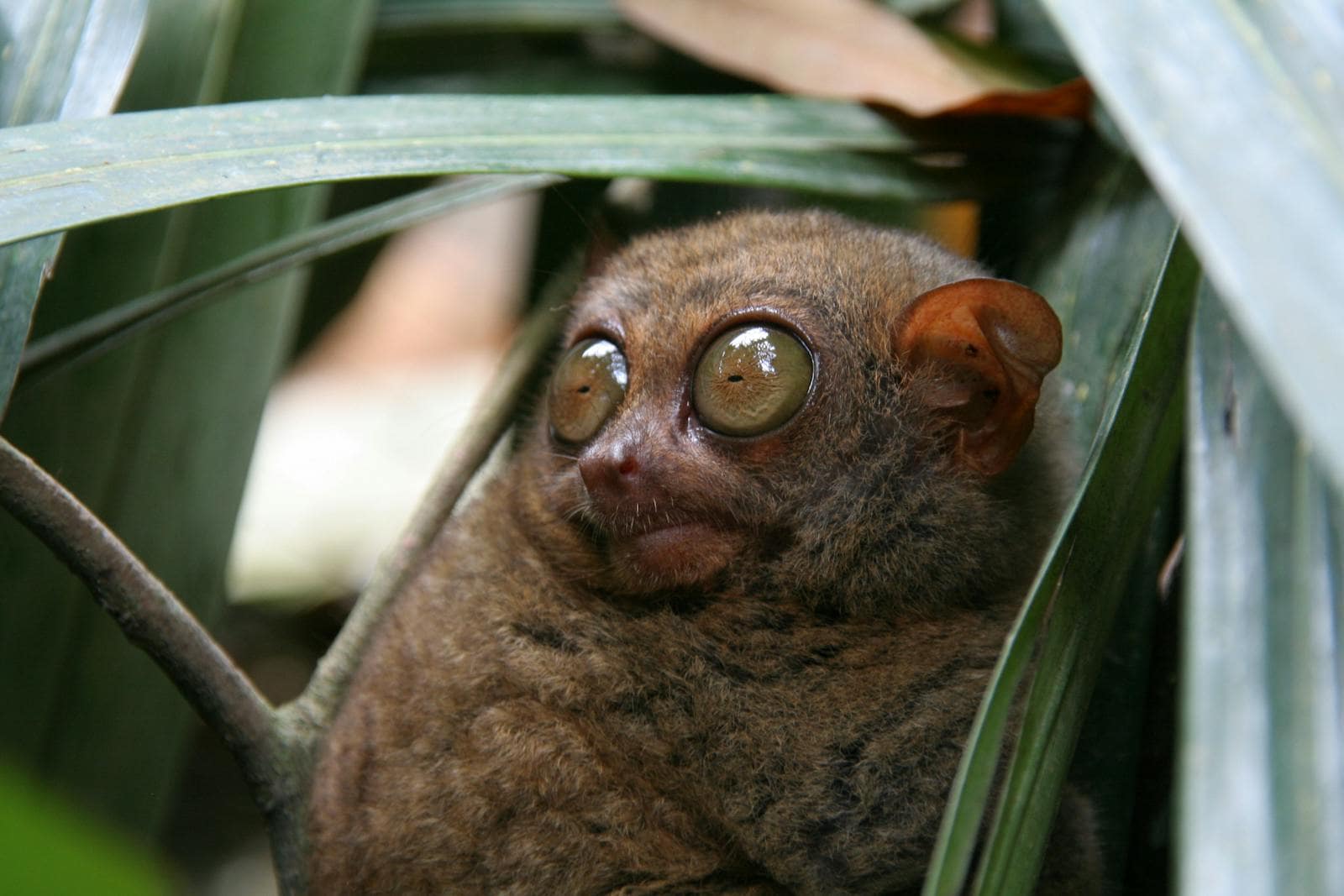
And given that our eyes as bipedal primates sit directly at the top of our bodies at front of the skull, our POV is from the front of our brains, where our thoughts and feelings appear to be. Each of us, with our individual and uniquely developed brains that produce only each our own unique selves and no-one else’s – this expression of each our own personality and intellect every waking moment of every day of our lives – this is an illusion? I think the Eastern mystics and their fawning fans like Harris and others sound more than a bit delusional. This is how living brains work. I think their “ultimate reality sans self” is the illusion. After a brief lapse of feeling one’s self inside their own body, either thru intense meditation effort or drug-induced neurotransmitter interruption, suddenly the self is the illusion and not the brief psychedelic or transcendent experience.
This “brain as container” assumption is not illusory either: damage a liver or a toe and your thoughts and language do not change, memories remain intact, sights and sounds do not change. Only damage to the brain itself can change the self – as we witness in the decline of faculties and personality from dementia and other maladies that affect brain function. The essence of what we are, what each of us is, our unique personalities and intellect, is mediated by different areas of our brains. What is so illusory or mysterious about all this?
Michael Graziano’s AST (Attention Schema Theory) suggests how our perception turns inward and we pay attention to what we are doing, thinking, feeling. The self is what the brain calls itself. We become a part, maybe the most important part of the model of the external world we built thru childhood and carry around inside our heads. “Me” moving among the other people, objects, places, and events, in both space and time: the present awareness of where we are right now and how we are moving (or not), or future imaginings of interacting with people and visiting places – scenario spinning of what we intend to do at a later date, maybe daydreaming of impossible but entertaining fantasies, or reminiscing of past episodes of our lives. This all occurs because there is a self who experiences.
Young children, starting at the toddler stage develop what I call ToP, Theory of Process, wherein kids are fascinated with watching, learning, about how things work: how they “go”. Even as adults we love to watch things operate, take off, mix and form, transform, operate: we want to know how the world works, how machines function, how life happens, diseases course, rivers run. Our motivation and curiosity is boundless.
We built the largest machine ever, the LHC (Large Hadron Collider), just to figure at the minutest, most primordial level how the fundamental elements of our existance interact and form everything we know about. We do this modern scientific investigation at the collective level, it is truly one of many global science endeavors involving hundreds, sometimes thousands of investigators, but all inquiry into how anything works starts with the individual, curious, human self. Without little kids and scientists wanting to know for themselves how things “go” there would be no understanding beyond the simple stimulus-response perceptual recognition of the animals. Every scientist with the drive to know, examines that aspect of our world that interests them, then shares that knowledge with the rest of us. All knowledge starts with the individual self and a formidable, usually lifelong drive to know.
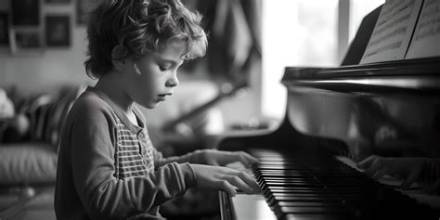
The psychologist, Matt Rossano has explained how a sense of self and conscious reflection is necessary for deliberate practice and self- improvement of any sort of skill. We are motivated to learn something or get better at some skill or another, and imagine our SELVES being better, accomplishing, succeeding – at whatever it is we are considering. And it takes dedicated and repeated self-monitoring, goal-setting, directed practice, and incredible amounts of study and dedication. No self?: no improvement, no motivation, no knowledge. It takes conscious experience and an acute awareness of self and of our current skill level to get better at anything and reach a higher level of achievement. We really have to pay attention to ourselves, learn about ourselves and how we best improve to practice and develop any sort of skill. First you have to imagine yourself performing at that level, then you need to figure out how to practice to get to that level, and you have to be very self-aware to monitor your progress, and keep working at it. “Ya gotta wanna” to achieve skill or understanding. “WE” get better knowledge all because whole hosts of individuals feel that burning desire: “I” wanna know!
Learning and exploring the patterns of the world outside our heads is incredibly appealing to us – and why that is would be the subject of an entire book-length essay, but it begins with ToO and object properties and the child’s ToP – exploring how things work and fit together – unfold and develop in time, be it a marble circling down the spiral tube in the gumball machine, a piece of music playing, or how plants grow.
Ironically, one of the most extreme and completely opposite examples of the self in action is the obsession with one’s own self experience to the point of lacking an interest in the world outside of our own heads (in fact somewhat of a disdain for it) that is found in the unending contemplation of the mystics. Despite many reclusives deciding in the end that the self is merely an illusion, they spend their lives in almost continual self-absorption, to the exclusion of interaction with others or the world around them. Discovering any new knowledge about how the world works is the exception rather than the rule (think the monk Gregor Mendel and his peas).
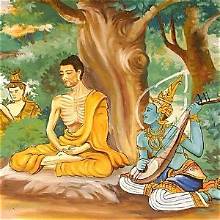
Over thousands of years of withdrawal from the outside world into the inner world of just their own experience and thoughts… instead of investigating and attempting to understand the world outside, what have the monks, gurus, cloistered ones, priests, shamans, mystics, devotees, hermits, ascetics, anchorites, visionaries, seers, prophets, and the like come up with? Nothing but mythological explanations, complex useless rituals, mystical proclamations, obsessive worship practices, intricate labyrinths of dogma – millennia of useless prayers and chants to non-existent gods and spirits: no science, no technology, no contribution to society. Withdrawing into ones own thoughts and daily rituals removed from society or from raising children or doing public service – the monastic life in a cave or a cloister – what has it ever really produced for the benefit of mankind?
To me its the ultimate selfish act. I mean groovy, if that’s what your personality is wired for and it makes you happy, go for it, knock yourself out, you don’t owe the rest of us anything – just don’t try and tell me it is some noble, worthy occupation to be admired. Its just withdrawal from society, from engaging in normal human empathy, or any real knowledge discovery. If that life is what you find pleasurable, by all means go for it. Just don’t tell me that decades of self-absorption produce anything, and certainly not the “great truths” of all time. Oh, please! Sam Harris claims the “great contemplatives” discovered “great truths” and then failed to list any of them in his “Waking Up” book – beyond the claims that the self is an illusion and the world is all about suffering and momentary escape from it is such a great thing…
Removal from the world into monastic devotion, solipsistic meditation, or continual worship of some supposed deity has gotten us nowhere, discovered nothing. Instead of denying the self, when one embraces the curiosity and ingenuity of their own brains/mind/selves mostly for the pure pleasure of knowing, of figuring out some intricate problem or process, discovering the “secrets of nature”, or the “mind of God”, the “ultimate meaning of the cosmos”, – whatever you may call it: we get all the knowledge the human species has gained and shared with each other. The innate curiosity of each individual, and drive for self-actualization – embracing normal human empathy and curiosity (instead of running away from it) has given us all the incredible scientific understanding we take for granted here in the early 21st Century. We like to figure stuff out and usually to make things better for ourselves, for all of us.
There would be no-one to think of anything, to build that model and recognize objects, places, people, and events without the elaborately evolved human sense of self. There is no knowledge of how the world works without a thinking, problem-solving, motivated human, figuring out what’s happening not solely just for survival needs, but for the pure pleasure of discovery and explanation. It takes a developed sense of self, as seen only in the human animal, to have the motivation and theoretical bent to discover how the world works. Just ask your dog: “Hey Fido, why DOES the wind blow or the grass grow?”…just sayin’.
In some sense then, the only thing that does exist is the self, or at least it is primary in that without it, we would know of nothing else that exists. An infant doesn’t know about baking cookies, black holes or blueberries – yet. It is awake, aware, alert, responsive, feels sensations, including pain and pleasure, feels hungry or tired – just like any other animal. However, wholly unlike the other animals the human infant develops over the 1st 5 years of life into a thinking, talking, highly inquisitive, theorizing, exploring little person, just wired to learn. And later its own interests will drive it to hobbies, past-times, puzzles, baking, cooking, carpentry, knitting, – any myriad of pursuits wherein they want to get better, to master a skill, to understand better. And some of us will be driven to science. Even those with the least interest in science still have some need for cognition. The vast majority of us want to get better at something, to learn, to understand better: even if it is just video games and getting to the next level or finally knitting a sweater that doesnt look like another Quasimodo custom design. We are not all out to discover the secrets of the Universe, but most of us are usually trying to figure out something or other. We just wanna know, we want to improve. It is how we roll. This is embracing the self, delving in our preferences and talents, discovering who we are, not denying it.
From this perspective, I think the self is not the least bit unnatural or illusory, or something to be shed for a glimpse at some “Ultimate Reality” as do many, such as the aforementioned neuroscientist, philosopher, and secular activist Sam Harris. The following is a decent summary of Harris’s view from his book “Waking Up” from the website “Shortform” – a concise explication of his ideas, influenced greatly by millennia-old Eastern Mysticism:
“According to Sam Harris, the self is an illusion. It’s this tenet, he contends, that lies at the heart of spirituality. A spiritual experience is the feeling of transcending your limited existence, freeing your awareness from the constant grind of anxiety, longing, sadness, and pain. Throughout history, many people have felt such transcendence, usually in the context of a religion that attributes moments of rapture to divine origin. However, since people of all faiths have had similar transcendent experiences, even between religions that directly contradict each other, then, logically, some factor outside of religion must be the source of the spiritual experience.
Harris argues that your feelings of identity and selfhood are an illusion created by a multitude of interlinked mental processes and that transcending the illusion of the self through deep contemplation is the core of spirituality as he defines it.”
This fawning over ancient suppositions over how the world works, how humans supposedly work, appears to be a religion of sorts for many like Sam Harris, who claim the mystics long ago (and for all time) figured out the self isn’t really real. Well maybe these ancient writers were just coming up with their best explanation at the time for how they assumed the human brain/mind worked.
Maybe like most writings, musings, or proclamations from a couple thousand years ago – they were just wrong, making it up as best they could using the limited knowledge we humans had at the time. Maybe we have learned a bit more since then about how the world and our brains actually work, and the self is not some illusory construct with which we delude ourselves daily – apparently through 99.9999…% of our waking existence according to the monks and gurus. Yet, even the mystical types who meditate regularly to some ephemeral, transcendent, selfless state, still spend the vast majority of their lives living with their self in normal operating mode: walking, talking, cooking, cleaning, eating, sleeping, (dreaming)…The self is what’s happening 24/7 for the contemplatives just like us regular folks: it is what we really are.
There would be no knowledge of anything without the self moving through that model of the world: an entire universe modeled now here in the 21st Century, in our heads – learning more about it every second we travel through it – building and expanding that model continuously from the moment we open our eyes. The self is not a concocted illusion – it is what we are, what every human critter is destined to develop into. It is the sum total of our personalities and intellect, our unique developmental trajectory, our accumulation of experiences stored in our episodic memories, and who we are socially in relation to colleagues, friends, lovers, parents, children, and community at large.
Think about it. Life has been on earth for at least nearly 4 billions years, beginning within a few hundred millions years of earth’s formation. And maybe because of the stability of earths orbit, its protective moon and the protective functioning of the gas giants Jupiter and Saturn and other parameters of earths path thru space and time, life was able to evolve under the incredibly stable conditions we find here on our home planet, and for long enough to produce a thinking, self-aware, theoretically modeling creature – us.
99.999..% of life’s existence was bacteria and unthinking animalia, the other critters with whom we share our DNA and much of our genes, cellular machinery, neurons, and neurotransmitters. And they don’t have a theory of the universe or an awareness of planets, black holes, gravitational lensing, viral infections, punk rock or cake pops …Only we humans with a self have a view of any and all things in existence. Bacteria don’t know they are bacteria, and your dog doesn’t know mass bends light, ass is a form of mass, or his mangy ass even exists. Or ANYTHING exists, for that matter.
NOTHING exists, but for the self – and its model of the world and all things that exist in it: dogs, bacteria, black holes, cake pops, and assholes like Trump and Putin. Bacteria, microorganisms, and plants don’t know any of this. Monkeys and chimps don’t know they are primates related to each other by DNA and evolution, or know they are on the third rock from the Sun. We do. Your dog doesn’t know that folks like Sam Harris and David Chalmers blather on about consciousness being something more than the outcome of molecular processes. It takes a thinking, learning human with a sense of self and a burning desire to know, and to know more to understand any of this. Without the human self there is nothing.
The universe and all that is in it has existed, according to our ever-expanding model – for nearly 14 billion years, but does the Universe know this, does any other intelligent, thinking critter that may have evolved somewhere else among the kabillions of planets orbiting the trillions of stars in the billions of galaxies know they and the rest of the Universe exists? At least in our galactic neighborhood – it is entirely possible we are the only ones that know ANYTHING EXISTS.
Without a thinking, theorizing, self aware, MOTIVATED TO LEARN, self – Nothing exists.
Somewhere along the line we discovered that boundary: like the cell wall which exists, even tho the cell never knows it to be so. But every human child rediscovers the self – it’s self. Michael Graziano says our attention is turned toward us, the self is what the brain, our brains, human brains call itself. It is not an illusion and every human child feels the touch of their own limbs to be different than touching mom’s arm and hands or their favorite rattle. It finds its own boundaries of me and not-me.

As the physicist and author David Deutsch notes, this is NOT a typical place in the Universe, and Earth may be the center of all knowledge known. One critter happened to evolve under the right conditions, one that models the outside world (now daily employing theoretical science), from the very same perceptual input the bacteria have been exposed to for nearly 4 billion years.
The infant discovers the boundary the cell and the animal never grok. The infant and the dog, chimp, crow, and rat all feel their own limbs, cold, pain, injury, warmth, comfort, unique to their bodies – Damasio’s bodily self. But we develop an embodied self-aware self, knowing WE, our selves, are within that boundary. We add ourselves within the bag of bones and skin with the forehead level birds-eye view, looking out on the world of objects and people outside our bodies.
Sam Harris’ and the Eastern Mystics emphasis on the “constant grind of anxiety, longing, sadness, and pain” reflects the first of the Buddhist 4 Noble Truths: “Life is all about Suffering”. Really? That’s what our daily lives are like? Nowadays in the modern world, generally, stranger’s smile at each other, we are feeding 9/10’s of the planet now, global peace broke out after WWII, we’ve discovered cures for cancers and modern medical treatments and global food production and distribution – all these have doubled our lifespans in the past century. With clean water at our fingertips, 24/7 heat and A/C, an abundance and variety of foods and entertainment to consume, the worlds knowledge in the palm of our hands summoned up in seconds…we experience luxuries as a matter of course that for the vast majority of human history even the elite of the elite didn’t, couldn’t enjoy.
We get up, go to work, many with fulfilling occupations we enjoy vs. long days spent in preindustrial agrarian drudgery, go to the store, have stuff delivered to our door from scrolling the Net on our smartphones, enjoy world class entertainment in the comfort of our own homes, raise children, experience sexual bliss (not all of us as often as we wish), indulge in varied delicious foods, and live twice as long as our ancestors did for most of the other 299,900 years of H. sapiens time on earth.
Sure, we all experience tragedies, loss of loved ones, financial hardships, medical crises and pain – but for the vast majority of humans how much of our lives is really dominated by anxiety, longing, sadness, and pain?
And isn’t the truly effective and real lasting antidote to those negatives, available to all of us: the love of friends and family, the useful diversion of fulfilling work, the care and cure from modern medical professionals, the beauty of sunrise and sunset, the smell of the air after a rain, and a myriad of other pleasures and truly transcendent experiences in nature and knowledge – instead of some rare, and fleeting temporary loss of self?

Most of us in the modern world and many across the millennia, even before modern medicine and conveniences, lived lives enjoying caring parents, the benefit of education, friendships and loves, the joy of raising children and accomplishments of self-actualization. Is life really all about suffering? Escape from what? The purpose of eluding the self is to avoid anxiety? For very brief moments the shutting off self works – and then what?
Even for the mystics, it is back to your normal, everyday, waking, thinking, self and the joys as well as the sorrows. For most of us in today’s world, and so many of the past it is not, was not all about suffering.
We’ve done so much better than to leave things as they are, and we can do even better. We have learned how to feed each other, cure disease and alleviate suffering, expand global travel and cooperation to avoid war, enjoy learning, luxuries, long lives, and self-actualization: engender even more and more human flourishing. Walling oneself off in a cave, monastery, temple, or sanctuary chanting meaningless syllables ad nauseum, eschewing further knowledge accumulation, denying progress, avoiding delight in normal human empathy – meditating or drugging the sense of self away – accomplishes what?
The Anthropologist from Mars’ ethnographic description might begin something like this:
So the human critter finds its edges and is wired to model the patterns of photons, air and mechanical pressure input from the moment it exits the womb into objects, other living things, and events/processes. Through synaptic proliferation in the trillions, this bipedal primate acquires conceptual knowledge unlike any other living entity on the planet. It can communicate the elaborate model it constructs in its brain within a year or so, including information about its own body/brain complex…which these humans quaintly call a “self”!
(6)
