
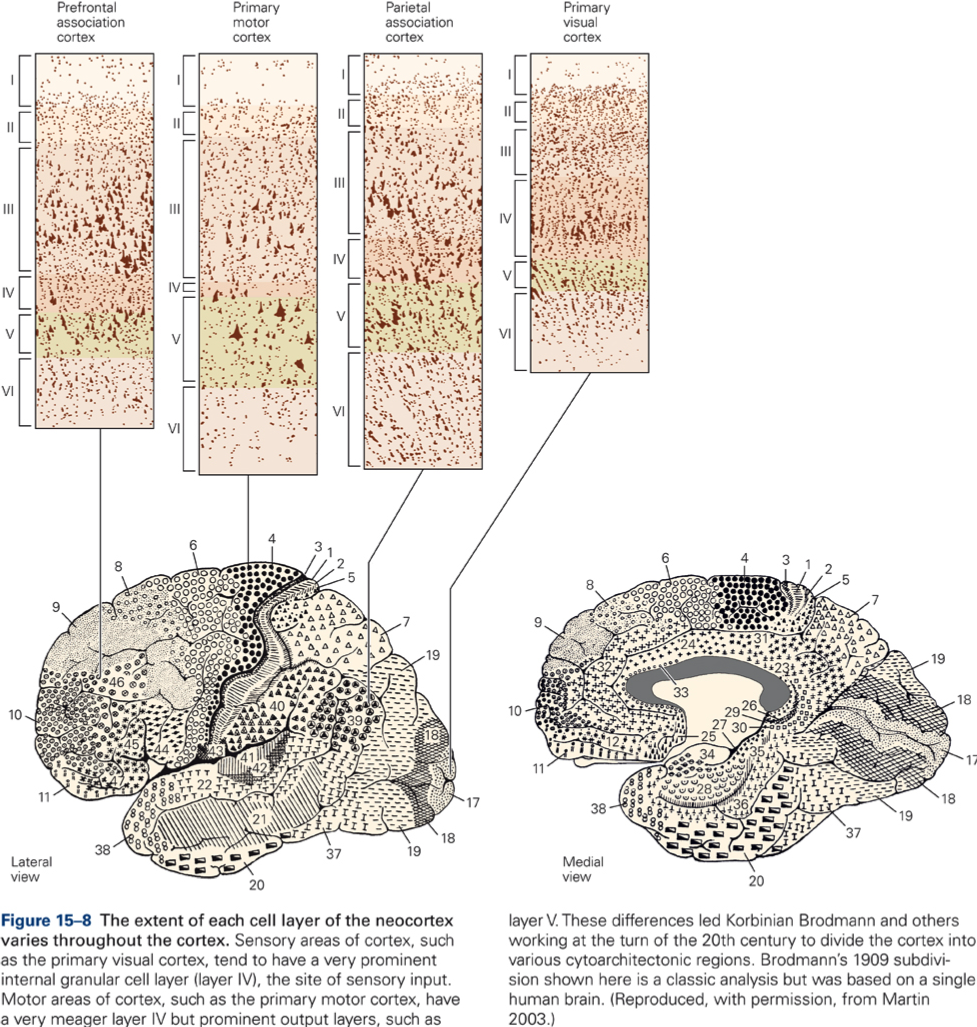
The considerable complexity of the human, conscious, brain.
And these few neurons – their cell bodies absorbed with stain in the 1-2 mm thick 6-layers of cerebral cortex that makes up the very visible and recognizable outer “bark” of the human brain, each have thousands of connections -synapses – with other neurons above, below, and even across the brain. So as complex as this image looks (and it is), this is but 10% maybe of the complexity exhibited in the trillions of those un-stained connections that overlay in one insanely tangled web all the neurons visualized here.
Pace, Kristof Koch, an otherwise very insightful researcher whose work in investigating consciousness is well-known and respected: but, you know what pal?…maybe, just maybe the complexity of the human brain – which is so largely untapped as you well know, may be up to the “mysteriousness” of consciousness after all and consciousness is not anything beyond an emergent property of the right collection of neurons – wired up as they are in a human brain.
Professor Koch explained on a Tik Tok reel, how he USED to be a materialist regarding consciousness, but now he just cant see that level of complexity emerging from mere matter, no matter how complex it maybe arranged itself. So now he is a pan-psychic. That consciousness is everywhere and that part of his reasoning is that the great physicist Max Planck said consciousness was a fundamental part of the universe, I guess like light and gravity…
Excuse me, but WTF did an early 20th century physicist know about neuroscience and consciousness? With all due respect to Professor Planck and his incredible work in physics:
#1 consciousness/neuroscience wasn’t his field and
#2 we have learned one hell of a lot more about the brain and consciousness in the 100+ years since Planck did his phenomenal work in physics… NOT neuroscience – physics.
A theoretical physicist who did not study consciousness, while brilliant, and responsible for the foundation of the greatest advance in modern physics: quantum theory – from a perspective of expertise in neuroscience and psychology, Planck’s opinion is worthless. Expertise matters.
If some consciousness researcher with a PhD in neuroscience or a related field with excellent research credentials in that field starting expounding on how quantum physics REALLY works – I aint listening to him either.
This ignoring of the value of expertise extends not from just goombahs like Joe Rogan and the Republican Xian Right, but has permeated to otherwise reliable and competent researchers like Koch – to whom we owe so much for elucidating the workings of consciousness in the human brain.
Evidently, he has embraced an anti-materialist approach due to a near-death experience he had.
“The mind accesses some fundamental aspect of reality that is more real than real.” – Kristof Koch.
Boy oh boy, doesn’t THAT just sound like the same old “mystical experience I cant explain equals ULTIMATE REALITY” psychedelic apologia from the 60’s or what?
So expertise matters here as well. Kristof has scads of it in the field of experimental psychology – specifically consciousness studies, but suddenly from a single and individual psychological event – he is an expert in metaphysics. Not from years of detailed observation, data collection, and experimental investigation into what reality is, but from one brief, subjective, mental interruption that only he experienced – he is now an expert on the subject of what’s really real and what isnt. One short subjective lapse in normal brain function and he “knows” all about reality. Maybe it’s just one person’s brain creating an experience only that person sees and feels and has nothing whatsoever to do with reality outside that person’s brain. One weird brief experience and suddenly he is making final pronouncements. Despite an admirable career in neuroscience and psychology of mind, he drops to the level of any other yahoo that has gushed similarly about their absolute certainty on some esoteric subject – on Joe Rogan.
Second, and equally important is Koch’s rejection of the idea of emergence: that a complex enough brain being is capable of producing the so-called “mysterious” complexity of consciousness.
As a counter-example, Koch clearly explains the emergent phenomenon of wetness of water being an emergent property of millions, billions, trillions of water molecules – sliding over each other as in any liquid – yet, adhering to one another with enough viscosity to bead up, and yet low enough viscosity to cling to and coat and wet a surface. One water molecule or maybe two or some insufficient number is not, are not wet. But millions can be, wetness is an understandably emergent property. No single molecule has the property of wetness.
However, he denies the possibility that similarly, no single neuron, nor two neurons, nor a column of 10,000 neurons while not being conscious, he denies that 20 billion neurons or more communicating trillions of times per second in an entire interconnected brain of cortex and various sub-cortical structures could be…
Koch has rejected this as he thinks the complexity and unique properties of consciousness are too much to be emergent from conglomerations of neurons alone. Like Dave Chalmers and others “there must be something more” to the brain: materialism just doesnt cut it for Koch anymore. Neurons alone just cannot do it.
This is an intuitive argument, not a logical nor empirical one – it just “feels so.”
I call bullshit.
#1. Fuck how Planck, Chalmers, Koch, and most humans still stuck in a spiritual bent, without really thinking about the utter failure of the spiritual approach as an explanation for anything thru the millennia, feel about it.
The universe doesn’t give a fuck what you prefer, it wasn’t built to please evolved human psychology. We are late comers (and that is an understatement) in the scheme of the universe. At 13.8 billion years old-we showed up as H. sapiens capable of theoretical modeling of that same universe only in the last 300,000 years, i.e., .0000217 of the Universe’s existence – that is 2.17 x 10⁻⁴ or a mere .002% of the Universe’s existence.
For 99.998% of the Universe’s existence it got along just fine without our recent attempts to model it.
#2. Supposing that our recently evolved psychology full of emotional yearnings and immediate “intuitions” (as opposed to empirical discovery and detached, reasoned theoretical analysis) determines how the Universe must be constructed is absurd in the extreme. We were not around to try and think about how the Universe works for like I said – 99.998% of its existence.

This is a good example, I suppose of what Alan Cromer in “UnCommon Sense” was getting at when he suggested that humans had to learn to not think egocentrically when observing the intricacies of the Universe, but allocentrically, from the outside: detached from us and our feelings, from our own intuitions: not how it appeals to us – but how it really is – whether matching our evolved intuitions or not (think quantum mechanics).
Thirdly: The water molecule-wetness emergence analogy falls more than a bit short. It quite clearly demonstrates the appearance of emergent properties but is wholly inadequate an example to compare to the complexity of the brain and the emergence of consciousness on a number of levels. The properties of water molecules producing wetness is reliant on their exactly similar structure and identical electrostatic attraction.
(Evidently 5 molecules don’t line up right, it takes six to make 3-dimensional droplet-like conglomerations – who knew? There’s a great study on that).
Every water molecule is just like the next one, with the same properties to produce wetness in huge numbers.
#1. Neurons are not all the same. There are dozens of different types of neurons and the interconnections of same which themselves are multifunctional with pre- and post-synaptic modulation and multiple neurotransmitters involved…incredibly more complex than the identical composition and structure of water molecules adhering to one another. The physicists often say there field is WAY more simpler than biology – this is a great example.
#2. Consciousness is itself a collection of brain functions: sensation, perceptions (including pain), embodiment, awareness, wakefulness, reflection, responsiveness, attention, and for humans: self-awareness – including episodic memory, imagination, and orientation in space and time and theoretical explanation. It is way more complex than the singular spatial fluidity property of wetness. Consciousness not only relies on billions of neurons interacting in the above processes but also is a function of the interconnectedness of various substructures within the brain: Default Mode Network as an example, language areas, attentional areas of the frontal lobes, arousal from brain-stem, and mid-brain structures and so on.
#3. Neurons don’t slide by and attract each other. Neurons interconnect in vast networks of not merely thousands of individual neurons, but in functional mini- columns of 100’s of neurons, columns of tens of thousands, nuclei and extended functional systems of millions of neurons, and interconnected whole functional areas and interconnected hemispheres comprising billions of interconnected and functionally discrete neurons.
#4. Neurons are not inert structures of 3 atoms (2 Hydrogen and one Oxygen per molecule and at least 6 molecules for wetness properties), but each are functioning cells of dozens of different molecules that accept input from and respond to thousands of other neurons tens to hundreds of times every second through complex chemical signalling.
#5 The untapped complexity and delineation of function with individual neurons, neuron mini and full columns and whole brain areas is enormous. We know how water molecules interact to make wetness. It is pretty straight forward and complete and is basically one simple property.
Yet with the brain and consciousness, we know some of the basics of visual perception and emotional processing for example, but we haven’t counted all the neurons yet, nor mapped anything more than their basic interconnections. We have barely scratched the enormous complexity as outlined above.
#6 Human consciousness is qualitatively beyond other animals’ awareness and perceptual processing. The conceptual abilities of the human brain and their significant content in our conscious awareness are just being explored. Our brains are advanced in neuronal organizations and interconnectedness beyond any other mammal or primate. As Steven Pinker puts it: it appears the complexity of the human brain is commensurate with the complexity of conscious experience. This is not at all like the single, simple property of fluid behavior comprised of non-functioning, simple, identical molecules with no organization at multiple levels, nor trillions of functional interactions each second.
#7 There is no evidence, only a few thousand years of spiritual yearnings, expressed in unfounded religious and philosophical claims of what that “something else” that produces or mediates consciousness just might be. David Chalmers has been blathering on about that supposed “something else” for over 35 years with no substantive proposal ever offered of what that something else might be.
So, Professor Koch, you had a mystical near-death experience that shut off parts of our very complex sensory experience of your own awareness inside the bag of skin and bones that defines you as well as your body. When those body maps shut off and you cant feel yourself inside your own skin, maybe you feel expanded and one with the universe and maybe your focused attention is shot too and you are overwhelmed by the continual sensory input that your brain when functioning normally filters to such a great extent and you interpret all that (as so many do) as the only TRUE reality that you just glimpsed – when in actuality, it was your brain – 1/2 shutoff and you experienced all that usual, normal, voluminous input abnormally for a few moments. And it overwhelmed the fuck out of you (understandably) but now YOU ascribe this sensory blast (sans being embodied) as the only true reality, when it was just your brain running fucked up. Oh, please. We’ve heard this plea before.
(9)
